Pfando review: Experience with the cash-for-car-title provider
Pfando buys your car and rents it back to you in the same step — you get cash and keep driving. The company has been on the market since 2010, shows 31 locations in Germany in its location list and states more than 50,000 customers. Requests start at €1,000. Neither SCHUFA nor income is checked; what counts is the value of the vehicle. The price is higher than that of an instalment loan — in return, the route stays open when a bank says no.
This page explains how the model works, what it costs, how repayment works and where it differs from a classic pawn loan.
Pfando at a glance
Pfando at a glance
| Loan amount | 1.000,00 € - 200.000,00 € |
| Duration | 1 - 120 month(s) |
| Specialties |
|
| Requirements |
|

- Receive cash for your car title without a credit or SCHUFA check
- Receive €1,000 – €250,000, no minimum term
- Car, company vehicle, motorcycle, van, and much more possible
- Not as cheap as a loan, but easier to obtain
What is Pfando?
Pfando is a provider that specialises in one model: sale-and-rent-back, which the company calls “cash & drive”. You sell your vehicle to Pfando and rent it back right away. You get the money the same day and keep using the car.
Several names are in circulation for the same model:
- Continue-driving option or continue-driving contract
- Sale-and-rent-back, sale-and-lease-back
- Pawn your car and keep driving — colloquial, but legally not a pawn loan
- Pawn your vehicle title, cash-and-drive
The difference from a classic pawn loan (page in German) is not a detail but the core of the matter: with a pawn loan, the car stays your property and is kept by the pawnbroker. With the continue-driving model, ownership passes to Pfando, and you drive a rented car. It is therefore also not a loan — no interest, no repayment instalments, no remaining debt, just a purchase price and rent.
For context: by its own account, classic pawn lending used to be part of the offer; today Pfando relies exclusively on the sale-and-rent-back principle.
How does Pfando work? Process and requirements
You can make a request with any type of vehicle: private car, company car, classic car, motorcycle, as well as van, truck, motorhome, boat or agricultural vehicle. The requirement is that you are the owner and that the vehicle is registered and insured. An ongoing financing or a lease rules it out — the vehicle then belongs to the bank or the lessor.
What you bring
- Registration certificate parts I and II (vehicle registration and vehicle title)
- ID card or passport, if applicable with a registration certificate of residence
- Driving licence
- The spare key — it stays with the provider
How does it work?
You make the request online or by phone. For the estimate, you are asked for make and model, first registration, mileage, accident or prior damage, the type of insurance and whether a service book is available. Then you book an appointment at a branch.
On site, an appraiser inspects the vehicle and determines its value and the possible payout. The continue-driving contract builds on this — more precisely two contracts: a purchase contract for a used motor vehicle and a rental agreement for the same vehicle. They state the vehicle value, the purchase price, the rental period and the monthly rent.
If you sign, you hand over the vehicle title and the spare key and receive the agreed sum — according to the provider the same day if the appointment is booked by 5 pm, by instant transfer or in cash. You drive home in your car.
The process in video

What does Pfando cost? Interest, fees and monthly costs
First, the classification, because it is searched for often: there is no interest in the strict sense here. You pay rent for a vehicle that no longer belongs to you. What is called “Pfando interest” in practice is the monthly rent. It is higher than what an instalment loan costs — in return, the SCHUFA query and proof of income are not required.
Cost examples
Examples based on customer statements, to show the order of magnitude. A concrete offer only results from the appraisal.
Compared with a classic pawn loan
With a classic pawn loan, the fees are set in § 10 of the German Pawnbroker Ordinance (Pfandleihverordnung) and can therefore be calculated. For a loan of up to €10,000 on a passenger car, 1% interest per month and a monthly pawn fee of 3.5% apply. In addition there is a storage fee, usually €75 to €90 per month.
In this example the difference is €252 over six months, i.e. €42 per month. In return, the car stays in use — a rental car for six months costs a multiple of that. The second difference weighs more than the price: with a pawn loan you redeem the car with the pawn amount; with the continue-driving model you buy it back, because it no longer belongs to you in the meantime.
Repayment and buy-back: what happens at the end
The most common question about this model concerns not the beginning but the end. Unlike with a loan, there is no repayment of principal: the rent pays for the use, it does not reduce the buy-back price. What you pay monthly does not bring you closer to owning the vehicle.
At the end of the rental period there are two paths: you buy the vehicle back at the agreed price, or the contract ends and the vehicle stays with the provider, who can sell it on. There is no statutory right of buy-back — § 34 (4) of the German Trade Regulation Act (GewO) excludes commercial buy-back transactions. What the contract contains is a buy-back option. It is also customary that a period runs before a sale in which you are informed; how long is stated in the respective contract.
If you fall behind with the rent, the provider can take the vehicle back — it holds the spare key for this purpose. Unlike with a pawn loan, you are not entitled to a surplus from a later sale.
These four points — buy-back price, period, default, sale — are the part of the contract where offers differ. There is case law on individual sale-and-rent-back contracts in Germany; abroad, separate rules apply in each case.
Cash & Drive FLEX: discontinued
Pfando has discontinued Cash & Drive FLEX (€200–€2,000, launched in June 2025). Requests now start at €1,000.
For smaller amounts, a short-term loan is an alternative — with it, the remaining debt falls with every instalment, but a credit check comes first.
Where are the Pfando branches?
Because the vehicle has to be appraised, an appointment on site is part of the process. According to its location list, Pfando currently has 31 locations in Germany, including Büsingen am Hochrhein, a German exclave surrounded by Switzerland. At the end of 2025 the list still showed 58 entries. The locations are these cities:
| Augsburg | Berlin | Bielefeld | Braunschweig |
| Bremen | Büsingen | Darmstadt | Dortmund |
| Duisburg | Düsseldorf | Essen | Frankfurt am Main |
| Freiburg | Hamburg | Hannover | Heilbronn |
| Ingolstadt | Karlsruhe | Kassel | Köln |
| Leipzig | Mannheim | Mönchengladbach | München |
| Nürnberg | Osnabrück | Saarbrücken | Siegen |
| Stuttgart | Ulm | Wiesbaden |
Addresses and opening hours are maintained by the provider itself — an address list kept here would be out of date faster than it is useful. For an assessment, the map is enough: in most regions of Germany a location is within reach.
What else you can pawn besides a car
For self-employed people, freelancers (page in German) and businesses, the commercial side is mainly of interest: vans, trucks or machinery tie up capital that can be released in the short term this way, without the business being left without vehicles. How the costs are treated for tax purposes is a matter for the business’s tax adviser.
Is Pfando legit? What can be verified
The question is asked often, and it is best answered with what can be checked.
| Company | Pfando Europe AD, Sofia (Bulgaria); the brand has been on the market since November 2010 |
| Size | 31 locations in Germany (according to the location list), about 120 employees, over 50,000 customers by its own account |
| Supervision | Consumer Protection Commission, Sofia (according to the imprint) |
| Visibility | nationwide TV advertising, including with Lothar Matthäus |
| Reviews | publicly visible on Trustpilot and Google, mostly positive |
What comes up most often in public criticism is the cost: the model is more expensive than a bank loan. That is true, and it is shown in figures above. On the other hand, a bank loan requires a credit check — for people with a negative SCHUFA entry or without current proof of income, the comparison with an instalment loan is therefore theoretical. The real choice often looks different.
Pros
- No SCHUFA query, no proof of income
- Same-day payout possible
- The vehicle stays in use
- Passenger cars, motorcycles, company cars, vans and more
- For businesses: liquidity without a credit check
Cons
- More expensive than an instalment loan
- Signed only in a branch, not fully online
- Ownership of the vehicle passes to the provider
- The rent repays nothing — the buy-back price stays
- A surplus from a sale is not yours
Contacting Pfando: phone, WhatsApp, mail
| Company name | Pfando Europe AD |
| Company type | Sale-and-rent-back provider |
| Address | bul. Botevgradsko shousse 247, 1517 Sofia, Bulgaria |
| Website | pfando.de/ |
| Not available | |
| Phone | 030 8877 3667 |
| 0160 622 6767 | |
| Hours | Mon–Fri 07:00–18:30, Sat–Sun 10:00–17:00 |
| Social Media | Instagram |
| English support | No |
| Specialty | Not available |
| Commercial register | EIK 208871751 |
| AEMIP member | No |
Sale-and-rent-back: where the model comes from
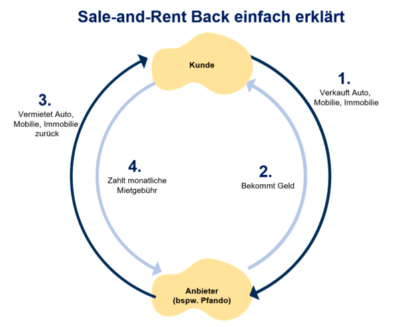
The principle is older than its use for private vehicles and has been common in corporate finance for decades. An example: a company owns its office building and needs one million euros, but the bank only gives it 200,000. So it sells the building to a real-estate investor for one million and rents it back for 10,000 euros a month. The money is there, the headquarters stays the same — ownership has become rent.
Airlines do the same with aircraft: a machine is sold to an investor and leased back for years because it is needed in operation. Pfando applies this pattern to the private vehicle. The difference from the corporate case lies in the scale and in the fact that a business with its own legal department negotiates differently from a private person under time pressure.
Alternatives to Pfando
Pfando is itself already the alternative for anyone who cannot get a loan or does not want to take one. Even so, it is worth looking at the other routes before ownership of the car changes hands. Some of the linked pages are available in German only.
| Route | What sets it apart | What it requires |
|---|---|---|
| Loan despite a negative SCHUFA entry | Cheaper, the remaining debt falls with every instalment | Regular income |
| Classic pawn loan | Fees capped by law, the car stays your property | You hand over the vehicle |
| CASHY | Pawn loan for electronics, luxury goods, cars and motorcycles, without a trip to a branch | An item of value that can be shipped |
| Money from private lenders | Private investors decide, not a bank alone | A comprehensible income situation |
| Owner loan | Uses existing property ownership as collateral | Ownership of a property |
Comparing through GIROMATCH is free, and the request runs as a conditions request that does not lower your SCHUFA score. GIROMATCH is a credit broker under § 34c GewO and does not grant loans itself — the partners decide on a request. Suitable starting points depending on your situation: car loan despite SCHUFA, loan despite wage garnishment or debt consolidation.
Frequently asked questions about Pfando
You make a request online or by phone and book an appointment at a branch. There, an appraiser inspects the vehicle and determines its value and the possible payout. Two contracts build on this: a purchase contract for the vehicle and a rental agreement for the same vehicle. After you sign, you hand over the vehicle title and the spare key, receive the money and drive home in the car.
There is no interest in the strict sense — you pay rent for a vehicle that no longer belongs to you. From customer statements: with a vehicle value of €4,000 and a payout of €2,500, around €297 per month; with a value of €8,000 and a payout of €4,700, around €450. The exact amount results from the appraisal and is stated in the contract.
Unlike with a loan, there is no repayment of principal. The monthly rent pays for the use and does not reduce the buy-back price. At the end of the rental period you buy the vehicle back at the agreed price, or the contract ends and the vehicle stays with the provider, who can sell it on.
Three points distinguish the model from a loan or a pawn loan. First, ownership of the vehicle passes to the provider. Second, the rent repays nothing, so the buy-back price stays where it is. Third, you are not entitled to a surplus from a later sale — with a classic pawn loan this would be different. In return, you keep driving, and neither SCHUFA nor income is checked.
Pfando has been on the market since November 2010. According to the imprint, the operator is Pfando Europe AD in Sofia (Bulgaria); the location list shows 31 locations in Germany, and the provider states about 120 employees and over 50,000 customers. Reviews are publicly visible on Trustpilot and Google. The most common criticism concerns the cost: the model is more expensive than a bank loan. That is true — but it assumes that a bank loan would be available at all.
You must be the owner, the vehicle must be registered and insured, and registration certificate parts I and II must be available. An ongoing financing or a lease rules it out, because the vehicle then belongs to the bank or the lessor. Requests can be made with a passenger car, motorcycle, classic car, van, truck, motorhome, boat and agricultural vehicles.